



The 2026 FIFA World Cup is not only showcasing world-class football but also highlighting how technology continues to shape the modern game. From Video Assistant Referee (VAR) decisions to the introduction of Smart Ball Technology, innovation has become a vital part of ensuring fairness, accuracy, and transparency on the pitch.
While technology has sparked debate among fans and football experts, there is no denying that it has significantly reduced controversial decisions during the tournament. Every goal, offside call, penalty decision, and handball incident is now examined more closely than ever before.
As the competition reaches its crucial knockout stages, VAR and Smart Ball Technology are expected to play an even bigger role in deciding matches that could ultimately determine the next world champions.
What Is VAR?
Video Assistant Referee, commonly known as VAR, is a system designed to assist the match officials in making the correct decisions during a football match.
Rather than replacing the referee, VAR serves as an additional set of eyes. A team of qualified officials watches the game from a video operation room using multiple camera angles. Whenever a major incident occurs, they review the footage and communicate directly with the referee if they believe a clear and obvious error has been made.
The referee can either accept the recommendation immediately or review the footage personally using the pitch-side monitor before making the final decision.
This process ensures that the authority remains with the referee while allowing technology to improve the accuracy of important calls.
When Can VAR Be Used?
VAR is only permitted to intervene in four match-changing situations.
The first is to determine whether a goal should stand. This includes checking for offside offences, fouls during the build-up, or handball violations before the ball enters the net.
The second involves penalty decisions. If the referee awards or fails to award a penalty incorrectly, VAR can recommend a review.
The third situation concerns straight red cards for serious foul play or violent conduct.
Finally, VAR can correct cases of mistaken identity, ensuring that the correct player is cautioned or sent off.
By limiting reviews to these four situations, FIFA aims to prevent unnecessary interruptions while maintaining fairness.
What Is Smart Ball Technology?
One of the most impressive innovations at the 2026 FIFA World Cup is Smart Ball Technology.
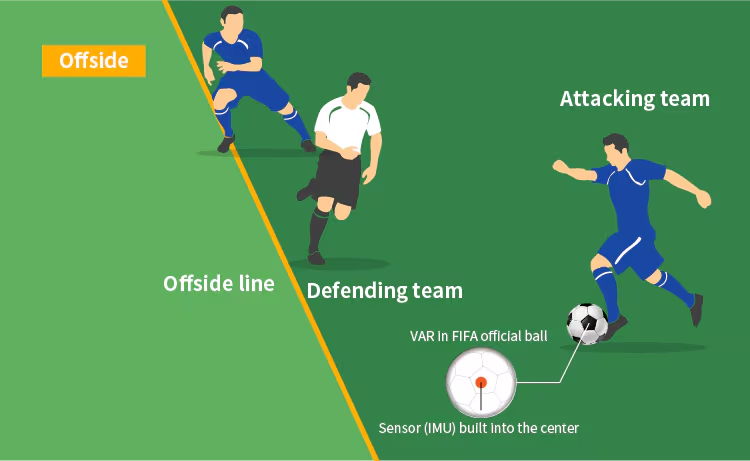
The official match ball contains an advanced sensor positioned at its centre. This sensor records data hundreds of times every second, providing extremely accurate information about the ball’s movement and the exact moment it is touched by a player.
The technology works together with player-tracking cameras positioned around the stadium. These cameras monitor the movement of every player on the field while the ball sensor records every contact.
By combining both data sources, officials receive almost instant information that helps determine offsides, handball incidents, and other close decisions.
The system has become one of the tournament’s most valuable technological advancements.
How Smart Ball Technology Improves Offside Decisions
Offside decisions have always been among the most controversial moments in football.
Before technological assistance, assistant referees had to rely solely on their eyesight, making extremely close calls difficult to judge.
Smart Ball Technology changes this completely.
The sensor inside the ball identifies the exact frame when the ball is played, while artificial intelligence tracks every player’s position. Together, these systems allow semi-automated offside technology to generate highly accurate offside decisions within seconds.
This has reduced delays while increasing confidence in the final verdict.
Although some decisions remain incredibly tight, the technology removes much of the uncertainty that previously surrounded offside rulings.
Benefits of Technology in Football
The introduction of VAR and Smart Ball Technology has brought several important benefits to the game.
First, it has improved decision-making accuracy. Match officials now have access to multiple camera angles and real-time data before making crucial calls.
Second, the technology promotes fairness. Teams are less likely to lose important matches because of obvious refereeing mistakes.
Third, it increases transparency. Fans watching in the stadium and at home can better understand why certain decisions are made after reviewing the available evidence.
Finally, the technology protects referees by providing additional support during high-pressure situations.
These advantages have helped improve confidence in officiating at the highest level of international football.
Why Some Fans Still Criticize VAR
Despite its advantages, VAR continues to divide opinion.
One common criticism is that reviews sometimes interrupt the natural flow of the game. Long pauses while officials examine incidents can reduce the excitement for players and supporters.
Others argue that football’s emotional celebrations are affected because fans often wait several seconds before knowing whether a goal will count.
There are also debates over subjective decisions, such as handball interpretations or the level of contact required for a penalty. Even with technology, these situations still depend on the referee’s judgement.
As a result, discussions about VAR remain one of football’s hottest topics.
The Future of Football Technology
The 2026 FIFA World Cup demonstrates that technology is now a permanent part of modern football.
As artificial intelligence continues to improve, future tournaments may feature even faster decision-making, more detailed player tracking, and enhanced communication between referees and supporters.
Rather than replacing human officials, technology is designed to support them by reducing mistakes and ensuring that matches are decided by the players’ performances rather than officiating errors.
Conclusion
While debates will undoubtedly continue, VAR and Smart Ball Technology have already transformed football. Their influence on the 2026 FIFA World Cup proves that innovation and tradition can work together to create a fairer, more accurate, and more exciting game for millions of fans around the world.